In the AI Era, Developers Have the Freedom to Refactor
A reflection on Bun's move toward Rust, a small SolidJS-to-Vue migration, and why technical choices in the AI era are becoming less like permanent bets and more like decisions that can be revised.
In the past, the first shovel of dirt on a software project felt unusually heavy.
Language, framework, folder structure, state management, deployment model: they looked like technical choices. In practice, they often became roads for the future. Build the road well, and the car runs smoothly. Build it crooked, and the car still moves, but it takes a ten-kilometer detour every day. After long enough, the driver starts treating the detour as part of life.
Software projects have stubborn inertia.
Today’s choice becomes tomorrow’s dependency. Tomorrow’s dependency becomes the next day’s constraint. Give that constraint enough time, and it gets a more familiar name: technical debt. The sharpest part of debt is often not in the code. It is in people’s minds. Everyone knows the system is awkward. Everyone knows it would be better to fix it. But once someone thinks about actually touching it, the hand pulls back.
Refactoring used to be heavy.
It rarely felt like replacing a chair. It felt more like changing the foundation of a building that was already full of residents. The windows had to stay. The water and electricity had to keep running. Nobody inside was supposed to wake up. Many teams eventually chose the same solution: nail a few more boards onto the wall. It looked reinforced. It also made the next repair harder.
In the AI era, that heaviness is starting to loosen.
Developers are beginning to regain something that had been missing for a long time: the freedom to refactor.
Chinese version of this article

Bun Made a Loud Sound
On May 14, 2026, Bun’s Rewrite Bun in Rust PR was merged into the main branch.
For a long time, Bun was known as a JavaScript runtime written in Zig. It was fast, sharp, and had the edge of a young tool. Seeing a PR like that is hard to ignore: a piece of infrastructure already running on many developers’ machines was moving its lower-level language toward Rust.
It was not a small PR.
More than one million lines added. More than two thousand files touched. More than six thousand commits. By older engineering instincts, this looks like an expedition. The road is long, the supplies are heavy, and people may fall behind halfway. In many commercial projects, the approval process alone would generate several rounds of slides.
It would be too easy to turn this into “Zig lost, Rust won.” The PR description is more careful. The codebase largely kept the same architecture and data structures. More optimization and cleanup work would follow. The non-canary release schedule still depends on official releases.
The more interesting point is that a fast-moving tool still had room to cut into its own foundation.
It did not look like burning the whole thing down. It looked more like replacing the steel in a bridge. The direction of the bridge remained. The load map remained. The goal of letting traffic pass remained. But the places that were easier to rust, crack, or cost too much to maintain could be rebuilt with a different material.
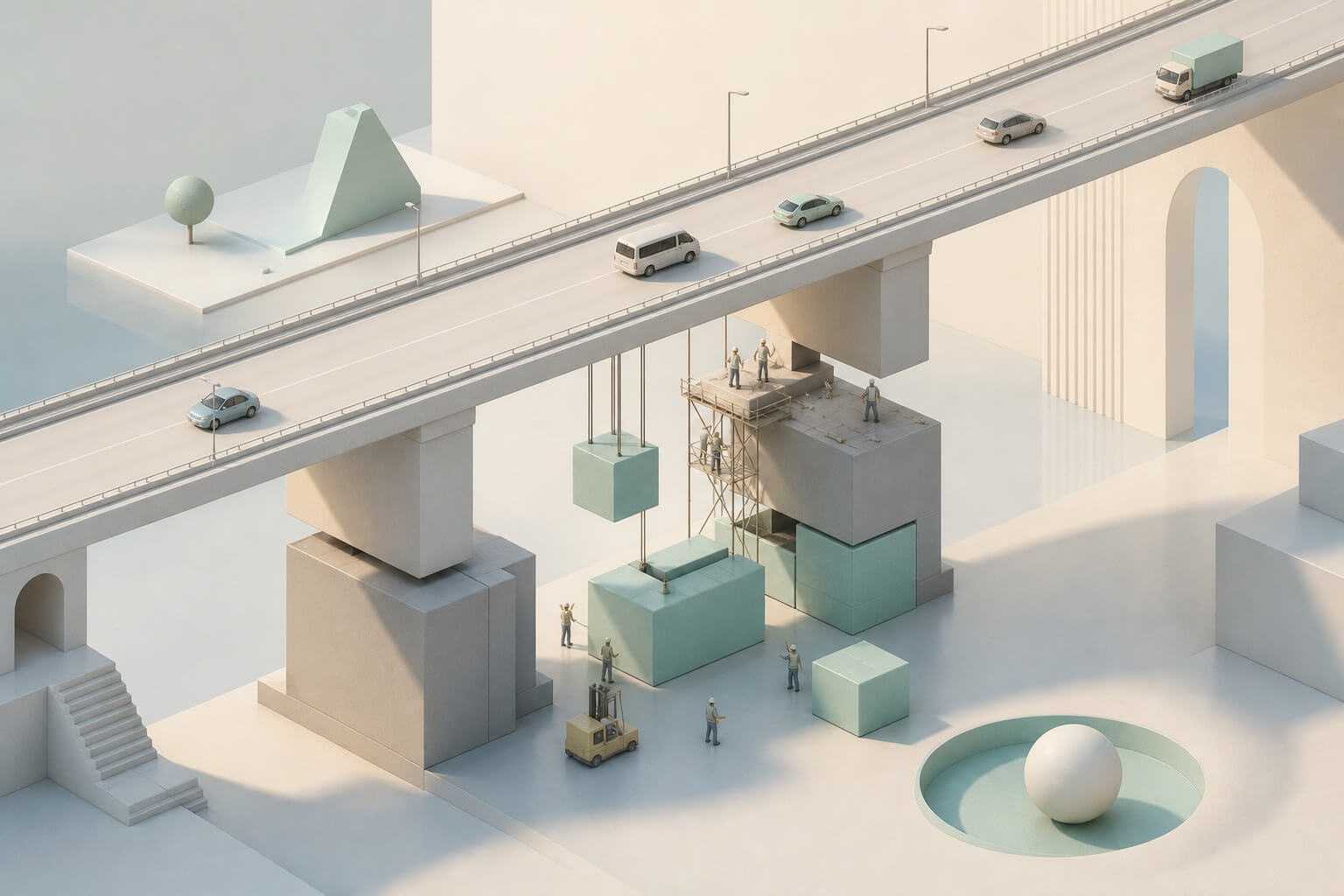
This kind of work was possible before. Possible and affordable are separated by a river. AI freezes part of that river, and people can finally try walking across.
It is a loud reminder: software does not have to endure its birth defects forever.
My Small Admin UI
I recently had a much smaller version of the same feeling.
I had an admin UI that was originally written in SolidJS. SolidJS has a beautiful reactive model, and it feels nice when writing demos. But real business does not eat ideas alone. An admin system needs tables, forms, dialogs, filters, permissions, menus, validation, imports, exports, enough components, and answers that are easy to find.
After writing it for a while, the conclusion was simple: it could be done, but it was slow.
Admin systems rarely need frontend philosophy. They need to be stable, fast, and low-friction. Users do not click Save one more time because a form is powered by an elegant reactive model. Developers do not write one less date-range picker because a framework has beautiful ideas.
In the past, I would probably have endured it.
Migration sounds troublesome. Components have to move. Routes have to move. State has to move. API calls have to move. Styles and small details have to move too. Even if Vue’s ecosystem clearly fits the admin UI better, it is easy to keep patching. Patch long enough, and the project gets old.
Now the path is more direct.
I organized the page behavior, API shape, component structure, and important business logic, then let AI migrate the project toward Vue with that context. The process still needed review, changes, and attention to detail. But the heaviest physical labor had someone else carrying it.

The human work shifted toward judgment.
Which behaviors must remain identical? Which old patterns can be discarded? Which parts should be cleaned up during the migration? Which parts should be left unchanged? Refactoring used to feel like carrying bricks. Now it feels more like supervising the site. Bricks are still bricks. Walls are still walls. But human hands no longer have to stay buried in cement the whole time.
Technical choices now feel a little less fated.
Choosing a framework used to feel like an early marriage. Whether it was suitable or not, you kept living with it. Now it feels more like a temporary partnership. If it works, continue. If it does not, settle the accounts, pack the belongings, and take another road.
The Fee for Changing Your Mind Has Dropped
AI has not abolished architecture.
It has abolished part of the superstition around architecture.
Many old choices looked sacred not because they were brilliant, but because changing them was exhausting. Change imports. Change call sites. Change type definitions. Change component patterns. Add adapters. Fix one batch of small errors after another. The direction was often visible. The problem was the mud between here and there.
AI is good at that mud.
Migrating similar patterns, rewriting repetitive structures, fixing code after failed tests, and making mechanical cross-file adjustments used to consume a lot of energy. They still take time, but they no longer feel as frightening.
Human attention can move a little higher.
Why migrate? Migrate to what? What counts as success? Which parts of the old system are business rules, and which are historical baggage? Which complexity should stay, and which complexity is only a hill of dirt left by years of wind?
Choices still have cost.
AI lowers the fee for changing your mind.
That matters. When the fee drops, people can try things more boldly. A new framework can be tested. A niche solution can be tested. A small project can start with the fastest path first. Early technical choices no longer have to be treated like inscriptions on a tombstone.
But do not run to the other extreme.
Change the framework today, the language tomorrow, and the database the day after, then call every appetite for novelty “architecture evolution.” That is just thrashing. Thrash long enough, and a project becomes a house under endless renovation. The wallpaper is always new. Nobody ever gets to live inside.
Freedom Needs Pilings
The freedom to refactor has requirements.
The first piling is design documentation.
Documentation should record why a choice was made. Code can tell people how the system runs now. It has a harder time explaining why someone took a strange turn years ago. Many odd implementations have business limits, historical compatibility, production incidents, or a night shift nobody wants to talk about behind them.
The second piling is tests.
Tests guard behavior. Large-scale refactoring without tests is like moving house at night. Everything seems to be loaded onto the truck. At dawn, the household register and the keys are missing. Beautiful code with broken user paths is the kind of bill nobody wants to pay.
The third piling is business layering.
The lower-level language can change. The middle framework can change. The presentation layer can change. Business rules should not be scattered everywhere. The more concentrated the business logic is, the more migration feels like moving house. The more scattered it is, the more migration feels like archaeology. Archaeology is possible, but every shovel may break something.
The fourth piling is rollback.

Refactoring that works on a branch is only half done. The other half is going online without hurting people. Phased migration, canary release, comparison checks, log observation, and old path retention may look clumsy, but they keep systems alive. AI can bring in the construction crew. The acceptance system still has to be built by humans.
With these pilings, a program has room to move.
When documentation, tests, boundaries, and version history exist, the first technical choice no longer looks like an imperial decree. It is a decision for a stage. It can be respected. It can also be revised when there is enough evidence.
Architecture Becomes a Sketch
Architecture used to feel like a stone tablet.
Once something was carved into it, people hoped it was correct enough, durable enough, and able to withstand years of weather. If the carving was wrong, changing the words was troublesome. Pushing the whole tablet over looked wasteful.
Architecture in the AI era feels more like a sketch.
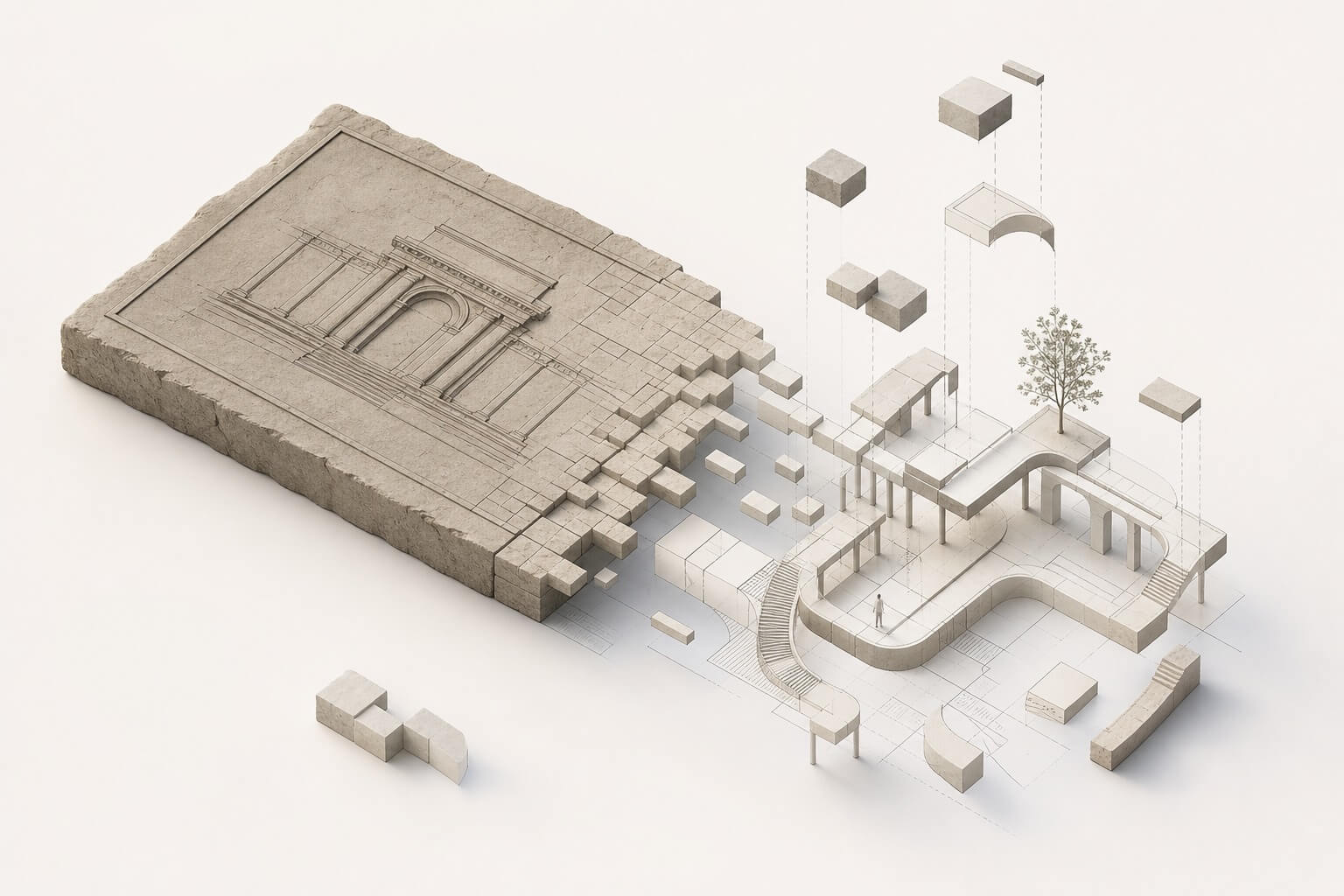
A sketch still deserves care. The proportions should be right. The boundaries should be clear. The emphasis should be visible. But a sketch admits that the future will change. It admits that today’s information is incomplete. It admits that a software system is a living production tool.
This changes how we look at new technologies.
In the past, the questions around a new framework were always familiar: Is it mature? Is the ecosystem large enough? Are the maintainers reliable? Will it still exist in three years? Those questions still matter. But one more practical question can be added:
Can we leave later?
Once that question appears, the scale changes.
A niche technology is not automatically dangerous. A popular technology is not automatically safe. A good solution has a reasonable exit cost. It protects business logic, data structures, and external contracts, so that replacing it later does not damage the bones. A bad solution may be popular today, but if it mixes business, framework, storage, build, and deployment into one pot, it is mortgaging the future early.
Many technical debts are borrowed under applause.
The Planning Question Has Changed
Initial planning still matters.
The question has changed.
The old question was: can we make the right choice the first time?
Now another line has to be added: if the first choice is not fully right, can we change it later?
This is closer to the real world. When many projects are born, nobody knows what they will become. Requirements change. Teams change. Traffic changes. Business models change. Ecosystems change. Asking a project to foresee its fate on day one is a little like asking a baby to fill out a retirement plan.
A more reliable method is to leave passages for the future.
Make interface boundaries a little clearer. Keep domain models a little cleaner. Keep tests close to real behavior. Let documentation explain key tradeoffs. Keep data migration conservative. None of this looks fashionable, but it can make the future person who has to refactor the system swear a little less.
That future person is usually yourself.
Technical Debt Becomes a Ledger
Technical debt will not disappear.
AI cannot eliminate laziness. It cannot eliminate complex business. It cannot eliminate wrong judgment. As long as software keeps running in the real world, debt will keep appearing. The difference is that old debt often felt like a court judgment. Once stamped, people were pinned down. Now it can feel more like a ledger. If the amount is clear, the interest is clear, and the repayment path is clear, there is room to turn things around.
This matters especially for independent developers.
When one person builds a project, being trapped by early choices is one of the worst outcomes. The framework is not a good fit. The ecosystem is inconvenient. The architecture gets more awkward. New features are hard to write. Old code is scary to touch. The project is not dead yet, but the developer has already been worn down by the code.
AI gives small teams and independent developers a return ticket.
You can start with a familiar solution and get the thing working. You can try a new framework to validate an idea. You can change the foundation while the product is still small. You can reorganize layers after the business grows into a new shape, instead of continuing to paste ointment onto the old structure.
But if every impulse is called refactoring, the system will soon be shouted apart.
Refactoring should move the system closer to the business itself. It should reduce the resistance of future changes. It should put scattered concepts back into place. Chasing new terms, changing skins, and adding a line to a resume are all possible activities. They do not need to borrow the name of refactoring.
Freedom Still Needs Discipline
AI has taken part of the heavy repetitive labor off developers’ shoulders.
That matters.
The most valuable ability of a programmer was never changing the same kind of code a thousand times. The more important ability is judgment: what deserves change, what should stay, what only works for now, and what will later tighten around the neck.
With AI, refactoring becomes a little less heroic. It can be more ordinary, more frequent, and closer to what engineering should have been: observe the system, find problems, adjust the structure, verify behavior, and move on.
Freedom needs discipline under it.
Dare to try, and know how to clean up. Dare to begin, and dare to tear down. Do not worship the first choice. Do not treat long-term structure lightly. Design documents, tests, business boundaries, and release discipline are the foundation of this freedom.
In the past, software projects often looked like trains forced onto the track of their first technical choice. If the track was crooked, the train kept moving forward, smoking all the way.
In the AI era, the track is no longer so sacred.
The road can change. The bridge can be rebuilt. The vehicle can be replaced. The destination must stay clear. The road needs markers. Every reroute must survive verification. If those things are in place, developers do not have to treat early choices as lifelong shackles.
AI has not relieved developers of judgment.
It has only lowered the wall built from repetitive labor. When the wall is lower, people can see the road beyond it.
Seeing it is not enough.
People still have to walk.
Loading discussion...
Discussion failed to load. Reload