Intelligence Is Becoming Aluminum
A personal reflection on shrinking frontend roles, increasingly capable coding agents, the falling price of intelligence, and why changing careers may be changing cabins rather than finding a lifeboat.
The company I work for has recently been reorganizing its development teams.
What used to be a large frontend group is being split across individual business teams. Frontend hiring is shrinking. Roles are no longer defined as narrowly around frontend and backend specialties. The company increasingly wants one developer to follow a business need from interface to server and deliver the whole thing end to end.
This can be described as an organizational adjustment. It can also be described as a move toward full stack. But for the people inside it, there is a more direct description: the same work is starting to require fewer people.
I started using AI coding tools heavily in 2024. Cursor, Claude Code, Codex: I have used them through nearly every major jump in capability. Early AI felt like a fast typist. It was useful for filling in small functions, writing boilerplate, and explaining errors. Later, it could complete a module on its own. Now I can use natural language as the primary input and let AI handle most of the coding for an entire system.
That is exciting.
Projects that once needed several people now feel possible to start alone. The expansion of individual capability is real. But another question appears at the same time: if one person can work this way, why will a company still need so many programmers?
Chinese version of this article
Frontend Is Only the First Alarm
Frontend roles currently seem to be taking the more visible hit. That does not mean AI is best at frontend work.
In my own use, AI often writes ordinary server-side business code more smoothly than frontend pages. When requirements, data structures, and acceptance criteria are clear, server logic can be checked quickly through types, tests, and runtime behavior. Frontend work has to deal with rendering, visual detail, interaction states, browser compatibility, and real-device behavior. AI has to keep taking screenshots, comparing results, and trying again. A human often needs to watch more closely.
Frontend may be shrinking first because its job boundary was the first to break. When one person with AI can cross old technical divisions, a company will naturally reorganize people around the business. For a developer, this is an expansion of capability. For the company, it is delivery with fewer people.
Both descriptions are true. They are two sides of the same change.
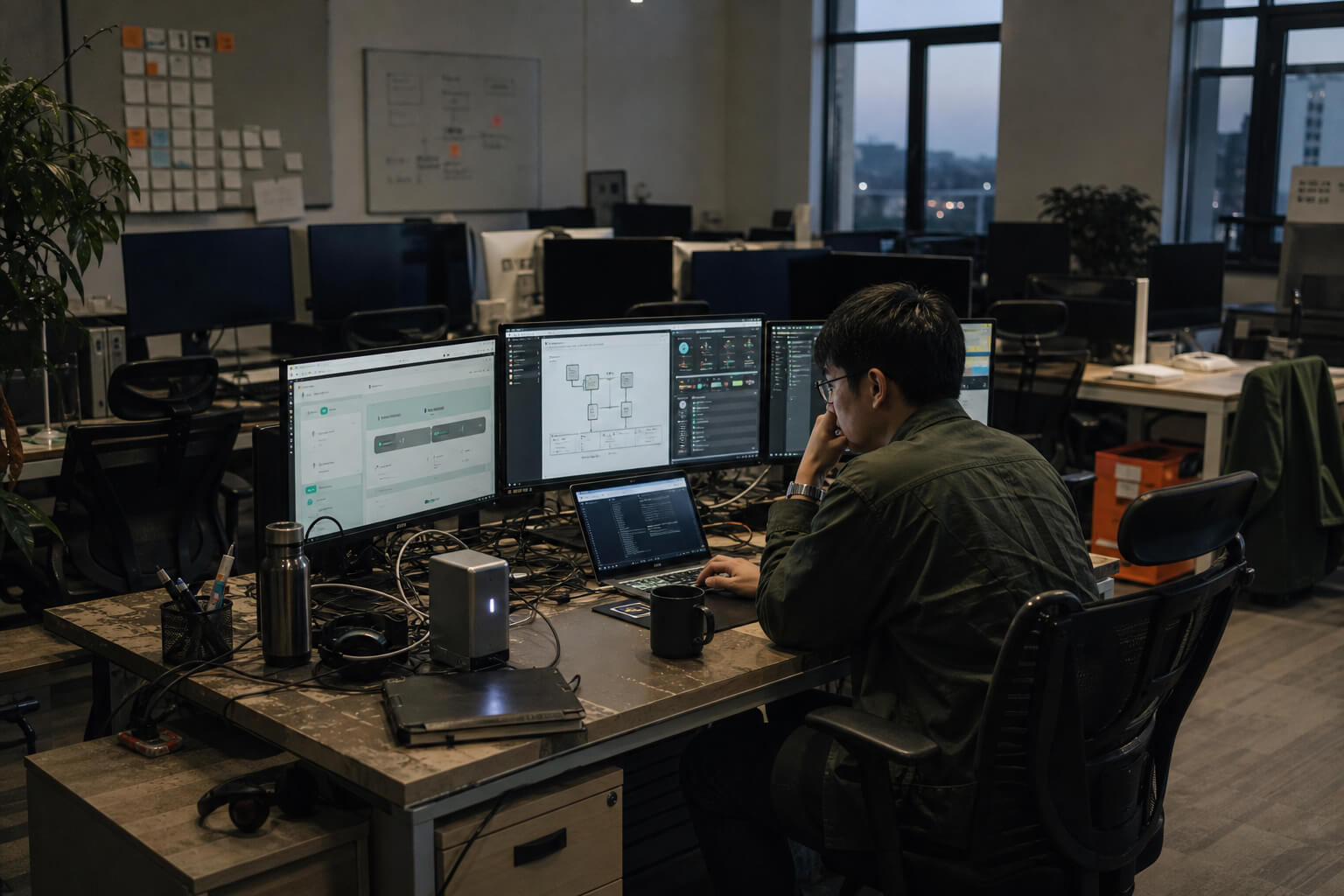
Moving from frontend to backend and becoming a full-stack developer is therefore a sensible choice today. It can help someone continue doing the work. It may not provide safety for much longer. Backend is not a shelter. Full stack is not a lifeboat.
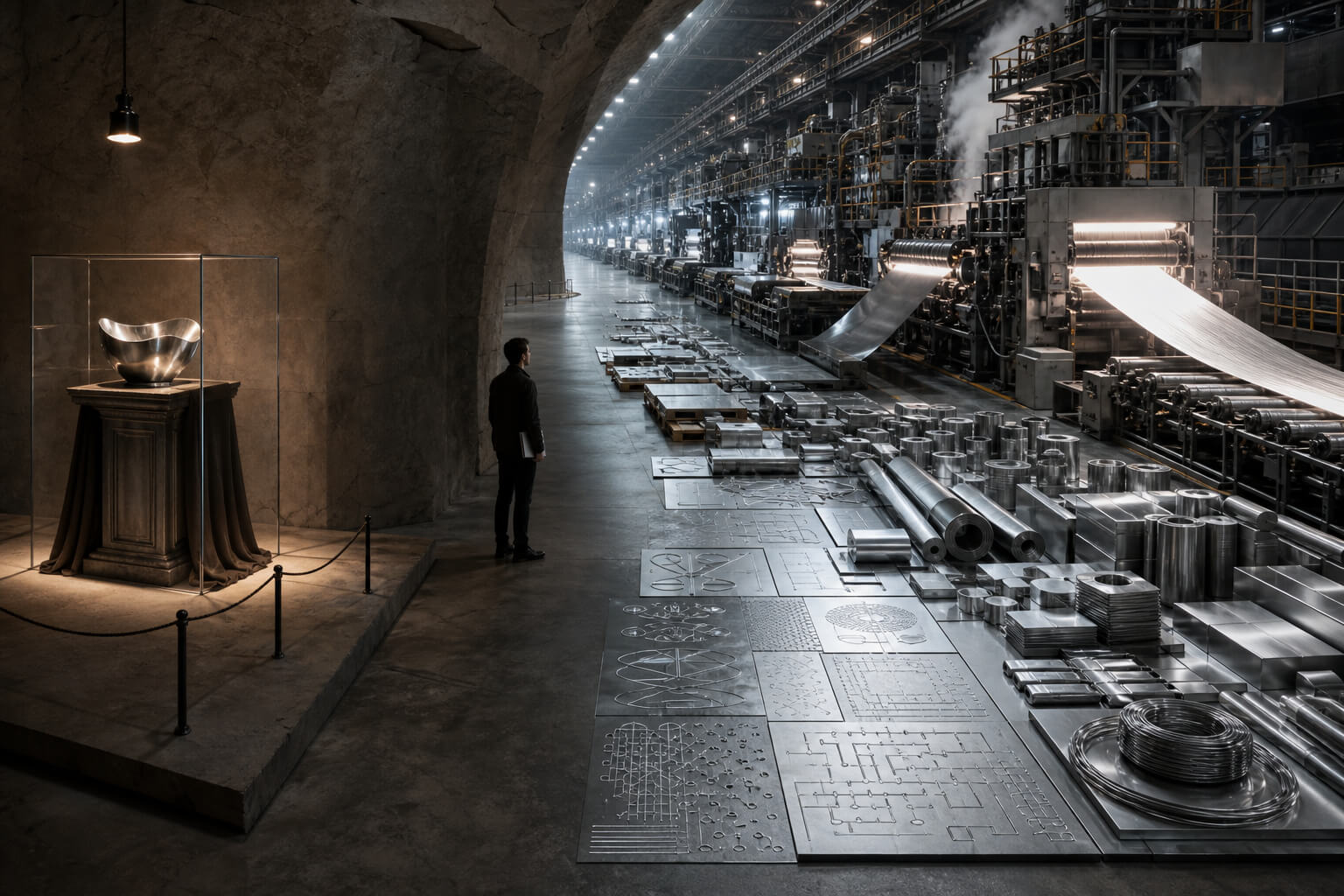
Why Intelligence Looks Like Aluminum
Aluminum is abundant in the Earth’s crust. The difficulty is that it is almost never found as a pure metal. People had used aluminum-bearing minerals for centuries, but isolating the metal itself remained extraordinarily difficult. In the mid-nineteenth century, aluminum briefly cost more than gold, and the few objects made from it became symbols of status.
A widely repeated story says Napoleon III reserved aluminum cutlery for his most honored guests while everyone else used gold or silver. The details may have grown in the retelling, but the story captures aluminum’s place at the time: it was not a cheap kitchen metal but a material fit for rulers.
The turning point came in 1886, when the American Charles Martin Hall and the Frenchman Paul Heroult independently developed a way to produce aluminum through electrolysis. Industrial processes improved, cheap and plentiful electricity reached factories, production soared, and the price kept falling.
Today aluminum is found in windows, beverage cans, power cables, cars, and aircraft. Humanity uses far more of it than it did when it was rare. Aluminum did not become useless. It went from royal tableware to an ordinary industrial material. What disappeared was not its utility, but the premium created by scarcity.
I increasingly think intelligence is going through a similar change. For now, I call it intelligence becoming aluminum.
In the past, turning knowledge into code, a contract, a design, or an executable plan required a trained person to spend time. That person’s education, experience, and working hours were part of the price of the intellectual output. AI is turning this into a production process that can be invoked at scale. Models, compute, data, and electricity resemble a new set of electrolytic machinery.
One reply is that generative AI is only a probability model, a recombination of human knowledge rather than genuine understanding or creativity. That argument can continue. Labor markets are usually less interested in philosophy. If AI-generated code runs, a proof survives verification, and a proposed solution solves the problem, the market will recalculate what it pays a human to produce the same result.
Intellectual work that is describable, reproducible, and verifiable will certainly feel the pressure earlier. Code happens to satisfy all three conditions, which puts programmers near the front. I do not believe the pressure will stop there forever. As models begin handling harder problems in mathematics, science, and engineering, “creativity is the final defense” no longer sounds especially comforting.
More Software Does Not Necessarily Mean More Programmers
When aluminum became cheaper, the world produced more aluminum goods. When intelligence becomes cheaper, the world will produce more code, design, analysis, and content.
This invites an easy mistake: if demand for software keeps growing, the number of programmers cannot fall. The amount of a product used and the number of people needed to produce it are not the same thing. Aluminum can spread across the world without raising the income of people who once produced it by hand.
The software industry may not disappear. It may become more productive and more widespread than ever. But the programmer labor market built around large numbers of specialized roles, large teams, and long delivery cycles can still contract. The more efficient software production becomes, the fewer people each unit of demand needs. That puts real pressure on both jobs and wages.
It may not arrive as one dramatic day when every programmer receives a layoff email. A company hires a few fewer people. An open role is not backfilled. Two teams become one. Work that used to be divided across several roles is repackaged into one job called “end-to-end ownership.” There is no ceremony. The number of people simply declines a little at a time.
Changing Cabins on the Titanic
Programmers are used to treating career anxiety as a learning problem. Frontend feels unsafe, so learn backend. Product engineering feels unsafe, so study architecture, algorithms, or AI. Coding feels unsafe, so move toward product, management, or consulting.
Each move may help for a while. But all of them share one assumption: trained human intelligence remains scarce.
If that assumption is weakening, moving from one knowledge job to another starts to look like changing cabins after the Titanic has hit the iceberg. Moving from third class to first class can buy comfort, access, and perhaps time. But once the ship is taking on water, an upgraded cabin is still not a lifeboat.

What I see at work is less dramatic and more ordinary. When roles begin to disappear, the people who look most important are often the ones who know how to present work upward. I do not mean empty self-promotion alone. They can also explain a complicated problem clearly enough for an organization to make a decision. In real workplaces, those two abilities often live in the same person.
AI can also write status reports, make slides, and summarize complex information. The mechanical act of producing a report will not be a durable advantage. What may remain scarcer is access to decision-makers, credibility inside the organization, and the power to define what counts as a result.
That sounds less like a professional skill and more like a person’s position in an organization. Positions are hard to copy. They are also impossible for everyone to hold.
One Person Can Build a Product. That Does Not Make It a Business.
Independent development looks like another possible lifeboat.
AI gives one person the productive capacity that once belonged to a small team. I also wonder whether individuals with AI can finally go toe to toe with established companies.
I have built products. They have had users, and some have earned revenue. But the income has been badly out of proportion to the effort, and it is nowhere close to a salary. Code was not the real bottleneck. Distribution was. Without sustained promotion, there were not enough users. The only project that made noticeable money relied mainly on organic traffic from WeChat Mini Programs. What created revenue was not only my ability to build the product. It was also an existing distribution channel owned by WeChat.
In China, a public-facing generative AI product also has to deal with filing requirements, content safety, and platform review. A large company can put legal, security, operations, and development teams around that list. An independent developer faces the whole list alone. Finishing the code only earns the right to enter the market.
There is another complication. AI applications do not fully follow the low-marginal-cost logic of traditional software. Each additional successful use may trigger another model call, consuming more tokens and compute. Users arrive, and the bill arrives with them. I wrote about this separately in Why AI Has Higher Marginal Costs Than Internet Software.
AI makes it easier for one person to build a product. It has not made it easier for one person to build a business.
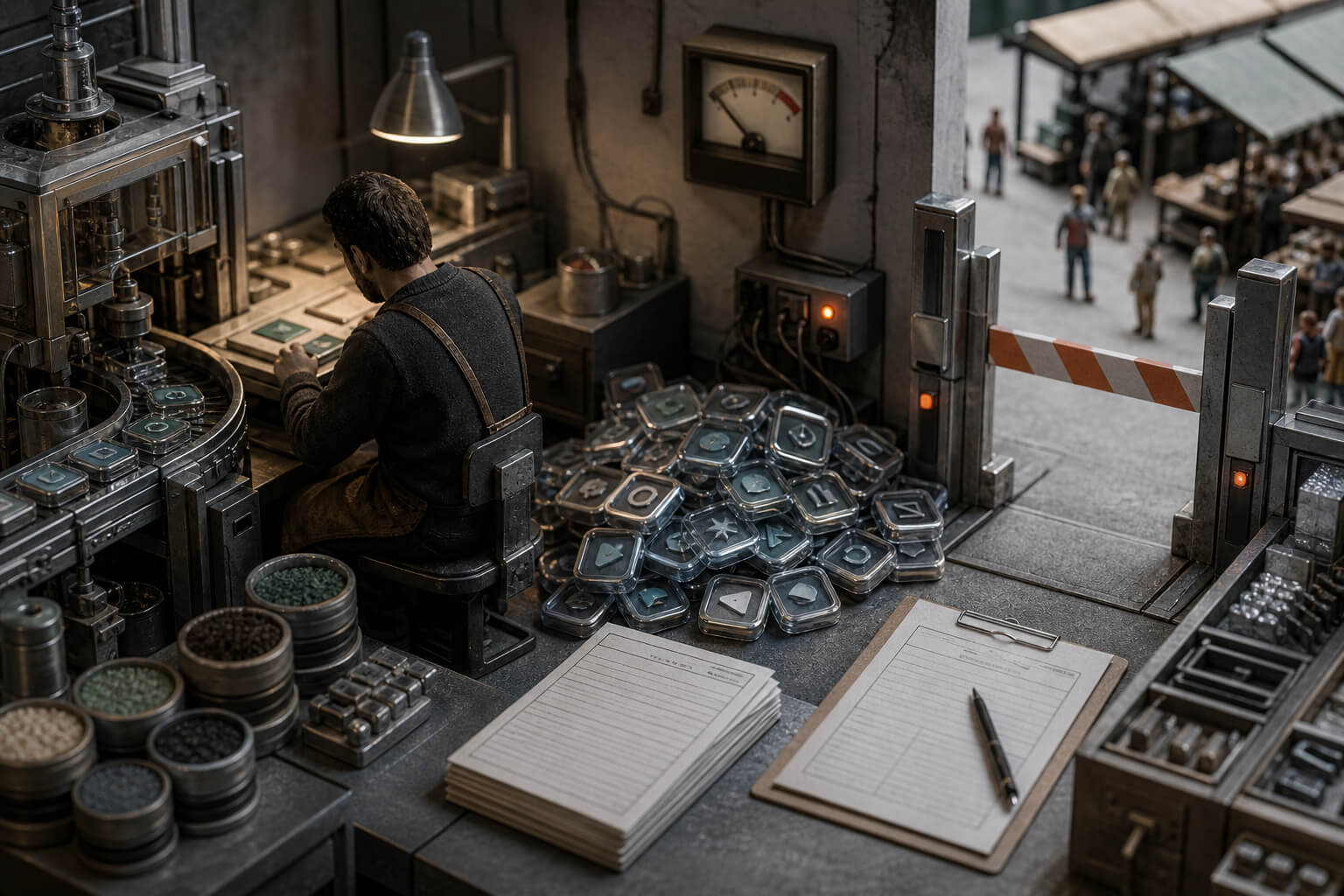
As the development barrier falls, product supply grows and competition becomes more crowded. User attention, distribution, brand, trust, compliance capability, and the capital to carry continuing costs become more scarce. Unfortunately, many of those things still sit with large companies.
Independent development is worth trying. It is not yet a proven lifeboat.
When Intelligence Gets Cheaper, What Gets More Expensive?
Every discussion about AI replacing a profession eventually arrives at the same comforting words: judgment, creativity, taste, responsibility, and human connection.
Those abilities matter. I am less confident that they form a wall AI cannot cross. As generation, analysis, and experimentation become cheaper, the parts of those abilities that can be expressed and reproduced will also be repriced.
What currently looks scarcer is decision-making power, customer relationships, distribution, organizational credibility, regulatory permission, and capital. Their common feature is that they are not only capabilities inside a person’s head. They are about which resources a person has the right to use, which relationships they can build, and how much of the output they can keep.
That answer offers little comfort to an ordinary worker. If ownership of the intelligence factory becomes the valuable thing, understanding the argument does not suddenly give a salaried worker models, compute, distribution, and customers.
Cheaper aluminum did not turn every aluminum fabricator into a shareholder of an aircraft company.
I Have Not Found the Lifeboat Yet
I still do not have a reliable answer.
Learning full stack matters. It expands the work someone can do today. It does not prove that the future will need more full-stack engineers. Learning to present work matters. It helps good decisions become visible inside an organization. It does not preserve today’s number of roles forever. Building independent products matters. It lets someone face the market directly. It does not automatically produce users or income.
None of that means doing nothing.
Refusing AI is not an answer. It only makes someone lose today’s competitiveness sooner. Continuing to use AI, learning across the stack, building independent products, and practicing operations and communication are all worth doing. They simply should not be mistaken for a guarantee of career safety.
AI has not delivered the leisure people imagined, either. Once I have paid for a subscription, unused tokens feel wasteful. Once AI finishes one thing faster, I immediately think of the next thing it could do. Time saved rarely becomes rest. More often, it becomes higher throughput. I become more capable, more tired, and more worried about the price of my own work at the same time.
That is what I mean when I say intelligence is becoming aluminum.
I do not know where the lifeboat is. At least I can stop mistaking a cabin upgrade for one. And I do not have to return to my cabin and sleep just because I cannot see the way out yet.
Keep using the tools. Keep making things. Keep talking to users. Keep watching the waterline.
None of this guarantees escape. But if a real lifeboat appears, it is better to already be on deck.
Loading discussion...
Discussion failed to load. Reload