The Price of AI Is Falling Absurdly Fast
From 2023 to 2026, the price of reaching the same level of AI performance fell about 47 percent per quarter. That pace changes what is practical to build and how much of it has to run in the cloud.
I once compared the cost of running an AI app to making things to order. A page I write once can be read by ten thousand people. If an app summarizes a different document for each of those readers, it has to run inference ten thousand times. For a cloud app, another use can mean another charge on the developer’s bill. I thought that would make it hard for AI apps to grow the way earlier internet products did. AI Broke the Zero Marginal Cost Myth of the Internet
Epoch AI’s chart brought that argument back to mind. The line for US residential electricity prices stretches across more than eighty years. The AI line gets only a few years to the right before it drops almost straight down. Both are drawn on the same time axis.
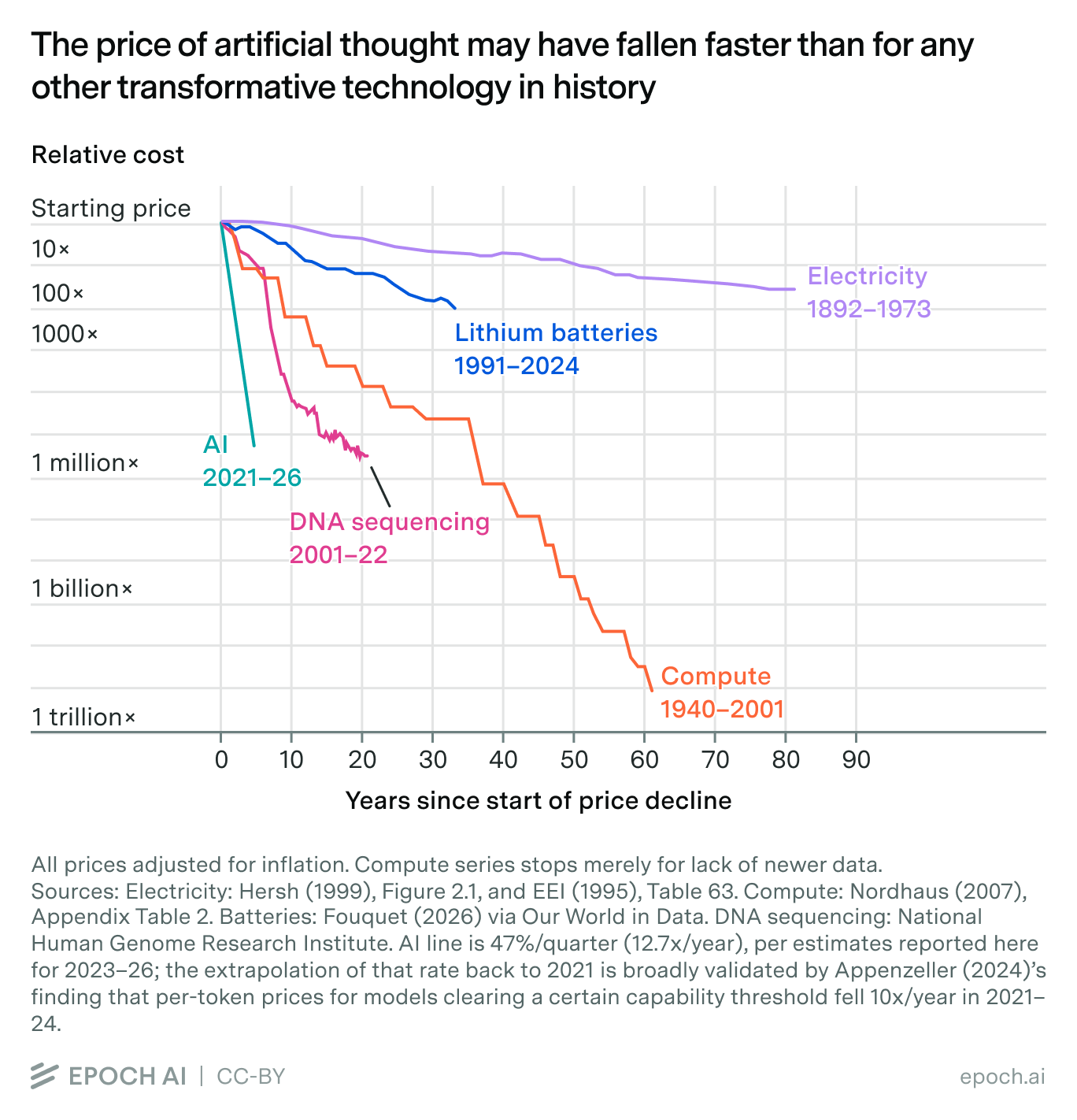
Chart by Luke Emberson and David Roodman, CC BY 4.0. Original figure from Epoch AI
From $100 to $8 in a year
Epoch AI looked at five benchmarks covering mathematics, science questions, and games of skill. For a given score, the researchers estimated the cheapest way to reach it at different points in time. From 2023 to 2026, that price fell about 47 percent per quarter on average. At that rate, a task that cost $100 would cost about $8 four quarters later. The portion of the chart going back to 2021 extends the measured rate backward.
On a logarithmic scale, AI inference prices fell about four times as fast as DNA sequencing costs, six times as fast as computing costs, and eighteen times as fast as lithium-ion battery prices in the periods the report compares. The decline was fifty-four times as fast as the fall in US residential electricity prices from 1892 to 1973.
One example gave me a better feel for the numbers. On a set of difficult multiple-choice science questions, reaching a given score initially cost about thirty cents per question. Less than a year and a half later, another model reached the same score at about $0.0004 per question. The money that bought one answer could buy hundreds.
Why did prices fall so fast?
Some tasks are initially within reach of only a handful of models. Give it a little time and smaller models can sometimes get the same results. When DeepSeek released R1, it also used the model’s worked solutions to train several smaller models. In DeepSeek’s published evaluations, one 32-billion-parameter version beat o1-mini on several math benchmarks. If a smaller model can take over your particular task, your costs can fall while the old model still sells at its original price.
The way a model is served makes a difference too. Chips get faster, memory bandwidth goes up, and serving software can get more out of the hardware already in use. vLLM, for example, manages each request’s cache in blocks to reduce memory waste and fit more requests on the same machine. In its original tests, it achieved two to four times the throughput of comparable systems at similar latency. The machine’s hourly cost was spread over more requests.
Prices also depend on how many options a buyer has. Early on, few providers can offer a new capability. Once several models can do a comparable job, customers can shop around. For a model with open weights, they can compare providers serving the very same model. My guess is that lower serving costs and competition happened together, and that helped prices fall as fast as they did. The chart tracks the prices available to buyers. It would take different data to tell how much provider costs or margins changed.
What gets used when inference gets cheaper
I expected cheaper models to lead to more spending on harder tasks. I underestimated what the price of a single call could do to the product itself. A feature that costs a dollar to run might be available only occasionally. At a few cents, it starts to make sense to put it in front of every user.
Take a manual. You usually write one version for everyone. A new reader might get stuck on a term. Someone who has used the product for months just wants to know where a button went after an update. If answering a question from the manual costs little enough, you can give each reader the explanation they need at the point where they get stuck.
Product feedback is similar. If a few hundred comments arrive every week, a busy team might get through only a sample. Grouping new feedback every few days makes it easier to spot a problem that comes up once in a while in several different places. The team might spend about the same and still get to see much more of the feedback.
Computers used to take up a room
There’s a story that Thomas Watson Sr. of IBM thought the world needed only five computers. IBM’s archive has a more specific account. In 1953, Watson Jr. told shareholders that the company had taken its proposal for the IBM 701 to prospective customers, expected five orders, and came back with eighteen. The machine rented for $12,000 to $18,000 a month. At that price, it made sense to go around asking who could use one.

An illustration of a 1950s computer room.
Personal computers eventually reached offices and homes. Later, a phone was enough to edit a document or trim a short video. A machine room still has its uses, but plenty of everyday computing happens wherever you happen to be.
Can language models make a similar move? Running a trained model takes memory for its weights and usually more room for a cache as the context grows. A data center can use GPUs with more memory or split a model across several cards. A phone has limited memory and cooling, and the battery has to last through everything else it does.
Better hardware can run bigger models. Techniques such as quantization can also make models fit in less memory. On devices that support Apple Intelligence, apps can already use an on-device model to summarize text and extract information offline. For a notes app, reading a page correctly and finding the things you need to do is enough to be useful.
What can stay on the device?
Say I want to organize a page of notes on a train. A cloud feature needs to upload the notes and wait for a response. On a spotty connection, even a few lines can take a while. If the notes have to stay on the device, the price of inference hardly matters.

When the whole operation runs locally, the notes can stay where they are and the feature can work offline. The model still uses memory and power, and the app has to work across different devices. The cost to the developer changes in one immediate way. Another use of the feature adds no inference charge to the cloud bill.
I expect we’ll use both. A device can handle routine jobs such as organizing a short note. A pile of long documents or a problem that takes more reasoning may still go to the cloud. Every common task a local model can handle is another thing you can do without a connection.
I used to think it would be hard for AI apps to attract users with a free product and make money from ads later. Inference was expensive enough that a new user’s costs could easily exceed the ad revenue they brought in. I think I made that call too early. Some features may get cheap enough for ads to cover them. Others may run on a device the user already owns. How much of an AI app can be free is a question worth asking again as those prices change.
Loading discussion...
Discussion failed to load. Reload